

How Much Can Businesses Save With Solar Panels in 2026?
From 1 July 2026, the Ofgem energy price cap rises 13% to £1,850 for a typical household. Businesses are not protected by it. Commercial energy rates track wholesale prices directly and those markets have spent the past five years delivering exactly the kind of volatility that makes long-term energy planning a serious challenge.
For UK organisations currently renewing contracts, reviewing energy strategy, or facing electricity bills that have doubled since 2020, one question keeps coming up: how much can commercial solar panels actually save?
For most businesses with daytime electricity usage and suitable roof space, the answer is significant and the numbers in 2026 are more compelling than at any point in the past decade.
Why 2026 Is a Pivotal Year for Commercial Solar Investment
Business electricity prices are not protected by the domestic price cap. UK commercial energy rates track wholesale markets directly and those markets have been volatile. The same global pressures driving the domestic cap to £1,850 from July 2026 are hitting business energy contracts just as hard.
For businesses currently renewing contracts or reviewing energy strategy, the case for self-generation has never been stronger:
- Grid electricity unit rates remain significantly elevated compared to pre-2021 levels
- Capital allowances allow 100% of solar installation costs to be deducted via the Annual Investment Allowance (AIA) in year one
- A 50% First-Year Allowance (FYA) is available for qualifying larger projects
- Commercial solar systems are exempt from business rates for 10 years
The financial model is straightforward: every unit of solar electricity consumed on-site avoids purchasing that unit from the grid at commercial rates. For businesses consuming 85% or more of their solar generation, returns are substantially better than those exporting the majority back to the network.
What is the ROI on Commercial Solar in 2026?
For UK businesses in 2026, commercial solar typically delivers:
- Payback period of 3–6 years (depending on system size, usage profile, and energy tariff)
- Annual ROI of 14–20% post-payback
- 25-year lifetime savings that can exceed £400,000 for larger systems
To put this in concrete terms: a 100kWp system installed on a warehouse or factory roof generating 85,000–90,000 kWh annually, with 80%+ self-consumption, can save in excess of £18,000–£24,000 per year at current commercial electricity rates. After a typical payback window, that electricity is effectively free for the remaining life of the system.
Savings example
Solar Generation 87,500 kWh
Self Consumption 80%
Energy Rate 28p per KWh
Annual Energy Savings £19,600
How Much Does Commercial Solar Cost in the UK?
Installed costs for commercial solar in 2026 run broadly from £550–£850 per kWp, depending on system size, roof type, and complexity. A 250kWp system will cost considerably less per kWp than a 30kWp installation.
Here is what that translates to at different business scales:
|
System Size |
Typical Application |
Indicative Cost Range |
|
100 kWp |
Small factory or large office |
£65,000–£90,000 |
|
250 kWp |
Medium-sized warehouse |
£160,000–£190,000 |
|
500 kWp |
Large logistics hub |
£325,000–£450,000 |
|
1 MWp+ |
Large industrial or multi-site |
Often sub-£700/kWp |
Larger systems benefit from economies of scale, a 1 MWp+ installation will typically come in below £700/kWp, making the financial case even stronger for larger sites.
Which System Type Is Right for Your Business?
The right configuration depends on your site, your energy profile, and your wider infrastructure plans. Here is a summary of the main commercial solar options:
|
System Type |
Typical Size |
Best For |
Indicative Cost Range |
|
Rooftop PV |
50–1,000 kWp |
Warehouses, offices, retail |
£35,000–£700,000 |
|
Ground-mount |
500 kWp–5 MWp |
Farms, distribution centres |
£325,000–£3.5M |
|
Solar carport |
50 kWp – 2 MWp |
Retail parks, campuses |
£80,000–£600,000 |
Rooftop PV remains the most cost-effective entry point for most businesses.
Ground-mount systems offer higher generation potential where land is available. Adding battery storage improves self-consumption rates and can significantly increase overall savings, particularly for businesses with evening or overnight energy demand.
Solar carports serve a dual purpose, combining renewable generation with covered parking and EV charging infrastructure.
Energy Gain UK can advise on the right combination for your site and model the financial case for each option.
Which Businesses Save the Most?
The highest savings go to businesses that:
Operate predominantly during daylight hours: Manufacturing, logistics, warehousing, food production, agriculture, and education all align well with solar generation profiles. These sectors use electricity as it is generated, maximising self-consumption and avoiding the grid at peak rate periods.
Have large, unshaded roof areas or available land: The more usable space a site has, the greater the generation potential and the stronger the financial case. Warehouses, Manufacturing or engineering industries, factories, distribution centres, and agricultural buildings consistently deliver some of the highest returns, precisely because their operational profiles align so well with solar generation.
Have high overall electricity consumption: The more you use, the more you save. Businesses spending £50,000+ per year on electricity typically see the strongest financial case.
Commercial Solar Savings: A Practical Example:
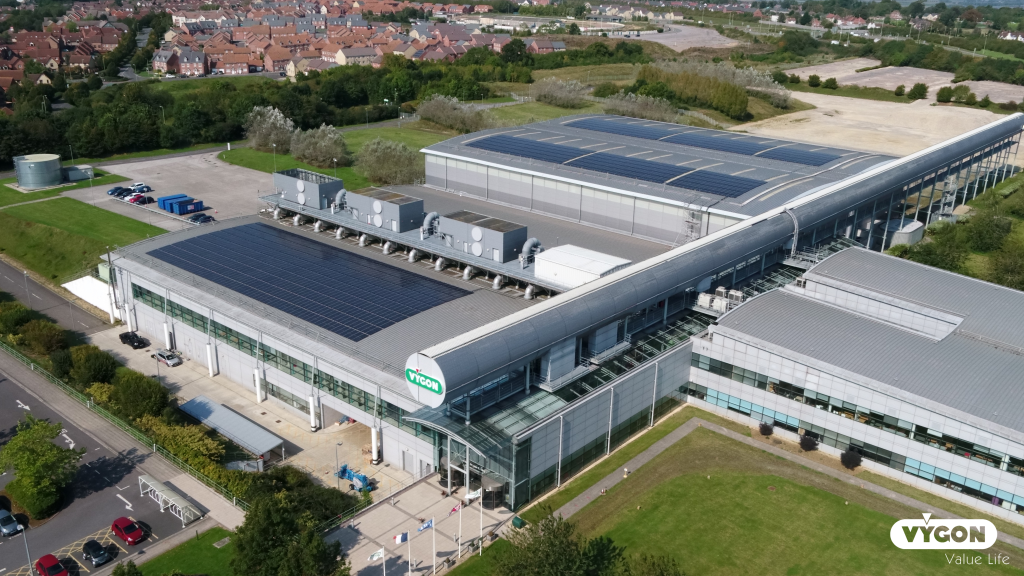
Vygon UK — 503 kWp Rooftop System, Swindon
Vygon UK is a medical device manufacturer supplying the NHS and healthcare sector across the UK. Reducing Scope 2 emissions was both a sustainability commitment and a commercial necessity, given the NHS’s sustainable procurement requirements throughout its supply chain. Energy Gain UK was appointed to carry out a full feasibility study, system design, supply, installation, and ongoing maintenance of a rooftop solar PV system at Vygon’s Swindon facility.
|
Factor |
Figure |
|
System size |
503 kWp |
|
Forecasted annual generation |
473,317 kWh |
|
Annual CO₂ reduction |
94 tonnes |
|
Annual energy bill saving |
£94k |
The system supports Vygon’s net zero ambitions while directly improving their competitive position in NHS procurement, where sustainability performance is assessed as part of supplier evaluation. The project also demonstrates how commercial solar investment can open new business opportunities, not just reduce costs.
“Working with Craig and the Energy Gain Team has enabled us to act quickly installing a 504kWp system. Craig’s availability and support aligned with the speed of the team’s response, ensuring the installation was seamless with minimal disruption.”— Vygon UK
Commercial Solar and Sustainability Obligations
Financial savings are the primary driver for most businesses, but commercial solar also delivers measurable sustainability benefits that are increasingly non-negotiable:
- Reduced Scope 2 carbon emissions
- Support for net zero commitments and carbon reduction plans
- Strengthened ESG performance and reporting
- Improved position in tender and procurement processes where supply chain sustainability is assessed
- Support for environmental accreditations such as ISO 14001
- Contribution toward Climate Change Agreement (CCA) targets, helping energy-intensive businesses demonstrate the carbon reductions required to qualify for a reduced rate of Climate Change Levy (CCL) on their energy bills.
As more organisations embed sustainability requirements into their procurement criteria, on-site renewable generation is shifting from a “nice to have” to a competitive necessity.
Finance Options for Commercial Solar in 2026
In 2026, there are several routes that allow businesses to access commercial solar without significant upfront investment:
CAPEX purchase — Own the system outright. Highest long-term return; eligible for full Annual Investment Allowance in year one.
Power Purchase Agreement (PPA) — No upfront cost. A third party owns and operates the system; you purchase the electricity generated at a fixed rate below your current grid tariff. Immediate savings from day one.
Lease to own — Spread costs over a fixed term while retaining ownership at the end of the agreement.
Green loans — Flexible finance designed specifically for renewable energy projects.
For many businesses, a well-structured PPA or green loan means solar can be cash-flow positive from month one, monthly savings exceeding monthly repayments.
Is Commercial Solar Worth It in 2026?
For the vast majority of UK businesses with suitable roof space or land and consistent daytime electricity usage — yes.
Payback periods of 3–6 years on a system with a 25-year performance warranty represents a compelling long-term investment. As commercial energy prices remain elevated and volatile, generating your own electricity provides both immediate cost savings and long-term price certainty.
The businesses that act now lock in today’s installation costs against energy prices that show no sign of sustained decline.
Find Out How Much Your Business Could Save: Speak to Energy Gain UK
Energy Gain UK has delivered over 2,600 renewable energy projects across 17 years of commercial solar installation. We work with businesses from initial energy profiling and financial appraisal through to system design, installation, commissioning, and ongoing maintenance.
Our team will assess your site, model your savings, and provide a clear financial case, at no obligation.
Book a free consultation with Energy Gain UK →
Or use our Solar Savings Calculator to get an instant estimate.

Frequently Asked Questions
How much does a 100kWp commercial solar system cost in the UK?
A 100kWp commercial rooftop solar system typically costs between £60,000 and £90,000 fully installed in 2026, including panels, inverters, mounting, cabling, and commissioning. Costs vary depending on roof type, system complexity, and location. Larger systems benefit from economies of scale and will generally cost less per kWp.
What is the payback period for commercial solar panels in the UK?
For most UK businesses with high daytime electricity usage, commercial solar panels pay back in 3–6 years. The exact payback period depends on system size, your current electricity tariff, and the proportion of solar generation consumed on-site. After payback, the system continues generating electricity at negligible cost for the remaining system life, typically 25 years or more.
Can I get commercial solar with no upfront cost?
Yes. A Power Purchase Agreement (PPA) allows businesses to have a solar system installed at no upfront cost. A third party owns and maintains the system; you pay only for the electricity it generates, at a rate below your current grid tariff. Savings begin immediately. Explore Energy Gain UK finance options →
How much can a business save with commercial solar panels?
Savings depend on system size, electricity consumption, and how much solar generation is used on-site. A 503kWp system at Vygon UK’s Swindon facility saves £94,000 per year in energy costs. A 100kWp system at a typical warehouse or factory can save £20,000–£25,000 annually. Energy Gain UK provides a detailed financial model for every site. Use our Solar Savings Calculator →
What is a Climate Change Agreement and how does solar help?
A Climate Change Agreement (CCA) is a voluntary agreement between UK government and energy-intensive industries that gives businesses a reduced rate of Climate Change Levy (CCL) on their energy bills in exchange for meeting energy efficiency and carbon reduction targets. On-site solar generation contributes directly to the carbon reduction metrics assessed under CCA agreements, helping businesses in sectors such as manufacturing, food and drink, and chemicals maintain eligibility for the CCL discount.
How long do commercial solar panels last?
Most commercial solar panels carry a 25-year performance warranty, guaranteeing output above a specified threshold for that period. In practice, many systems continue operating effectively well beyond 25 years. Inverters typically require replacement after 10–15 years, which is factored into long-term financial models.
