
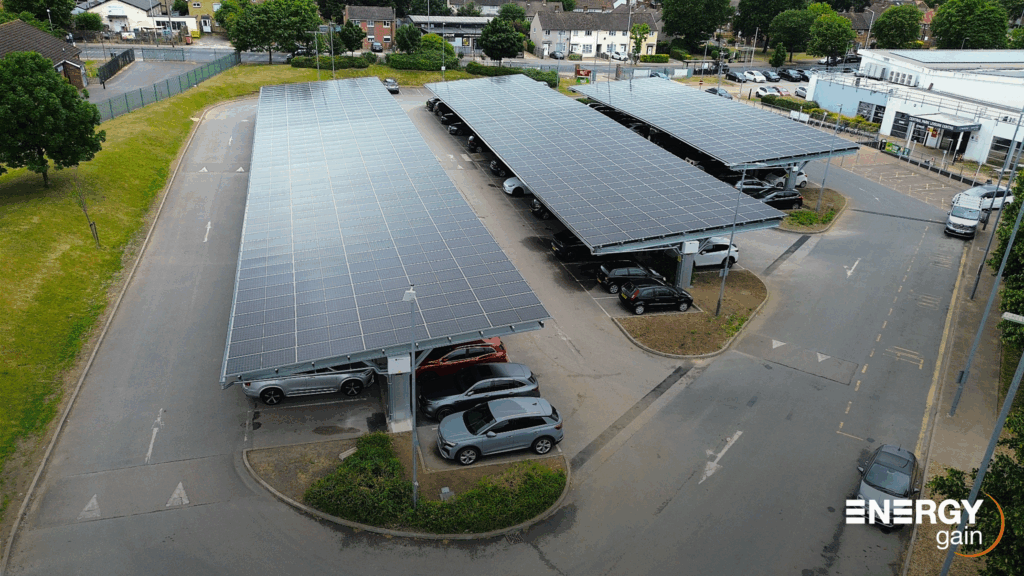
Do Solar Canopies need Planning Permission?
In many cases, yes. Commercial solar canopies often require planning permission because they are treated as standalone structures rather than simple alterations to an existing building.
Whether planning permission is required depends on factors such as the scale of the structure, site location and any relevant planning constraints.
Because commercial solar canopies are often installed within active environments such as car parks, planning constraints, access requirements and site operations should be considered from the outset.
While some smaller solar installations may benefit from permitted development rights in certain circumstances, these rights do not automatically apply to solar canopies. This is because canopies typically involve new permanent structures, often requiring steelwork, foundations and associated electrical infrastructure.
When assessing a planning application, local authorities typically consider visual impact, surrounding environmental effects, drainage arrangements, access and highway safety, heritage constraints, ecology and biodiversity impacts. Larger or more complex projects may also require technical evidence submitted alongside the application such as transport statements, flood risk assessments, structural calculations, arboriculture surveys, ecology reports or glint and glare assessments.
In practice, the planning route can vary significantly between councils. A canopy that is acceptable on an industrial estate may face more scrutiny if it is visible from nearby homes or located in a sensitive area. Early discussions with the planning authority can often highlight issues before significant design costs have been committed.
Understanding Permitted Development Rights
Some solar developments in the UK can proceed under permitted development rights.
Permitted development allows certain building works to take place without a full planning application, provided specific criteria are met.
However, solar canopies do not always benefit from the same permitted development rights as rooftop solar.
This is because:
- They create a new external structure
- They can significantly alter the appearance of a site
- They may affect parking layouts or access routes
- They often involve structural steelwork and foundations
In many commercial situations, planners will require a full application regardless of canopy size.

Common Challenges That Can Delay Solar Canopy Projects
One of the biggest challenges is ensuring that the proposed canopy works alongside existing site operations. A common mistake is designing the structure around the maximum number of panels rather than how the site operates. A car park still needs delivery access, pedestrian routes, lighting, maintenance access and room for vehicles to manoeuvre during construction.
Coordination between planning approval and technical requirements is essential, as projects may face delays if supporting infrastructure is not considered early.
Structural, electrical and compliance requirements, including drainage solutions, structural assessments and electrical upgrades, should be incorporated into the project design process to avoid unexpected costs or delays during construction.
What Factors Do Planning Authorities Consider?
The level of scrutiny will vary depending on the size and location of the project, but commercial developments are typically assessed against several key planning considerations.
Site Location
The location of the proposed canopy is often one of the first factors considered. Sites within conservation areas, Green Belt land, National Parks, Areas of Outstanding Natural Beauty (AONBs) or the setting of listed buildings are generally subject to stricter planning controls. Local planning policies may also place additional requirements on developments in environmentally or visually sensitive locations.
Scale and Design
Planning officers assess whether the size, height and overall design of the canopy are appropriate for the site. This includes considering the structure’s footprint, roof profile, supporting columns and relationship with nearby buildings.
A solar canopy that is appropriately scaled and integrated into the site is more likely to achieve planning approval than one that appears visually dominant or out of keeping with the existing development.
Visual Impact
The visual effect of the proposal is an important consideration, particularly where the canopy is visible from public roads, neighbouring properties or open landscapes. Authorities may review the choice of materials, colour finishes, architectural appearance and any proposed landscaping or screening designed to reduce its visual impact.
Motorways, Access and Parking
For solar canopies installed over car parks, planners will assess whether the development affects the safe operation of the site. Considerations may include vehicle circulation, maintenance access and day-to-day site operations, pedestrian access, emergency routes, visibility at site entrances and the overall functionality of existing parking spaces.
Where EV charging infrastructure forms part of the project, authorities may also consider the placement of charging equipment and associated electrical infrastructure.
Drainage and Flood Risk
As solar canopies increase the amount of covered surface area, drainage is another common area of scrutiny. Local authorities may require evidence that surface water can be effectively managed through Sustainable Drainage Systems (SuDS), attenuation measures or other drainage solutions, particularly on sites located within flood risk areas.
Ecology and Environmental Considerations
Larger developments may require an assessment of their potential impact on local habitats and biodiversity. Depending on the site, planning authorities may request ecology surveys, tree protection measures or biodiversity enhancement proposals to minimise environmental impacts during construction and operation.
Glint and Glare
Modern photovoltaic panels are designed to absorb sunlight efficiently rather than reflect it. However, where solar canopies are proposed near roads, railways, airports or residential properties, planning authorities may request a glint and glare assessment to demonstrate that reflected light will not create safety or amenity issues.

Solar Canopy Design and Site Integration
Beyond meeting technical requirements, solar canopy design must balance energy generation with practical site requirements. Factors such as column placement, materials, roof profile and access arrangements can influence how effectively the structure integrates with the surrounding environment.
Planning officers will typically consider factors such as the arrangement of supporting columns, roof profile, materials, finishes and overall layout which can influence how effectively the canopy blends into the site.
A well-considered design approach can help minimise visual impact while ensuring that the canopy remains practical for vehicle access, maintenance and future operational requirements. This is particularly important for larger installations where the structure may become a prominent feature within the local area.
Pre-Application Advice and Planning Strategy
Before submitting a formal application, many commercial developers choose to engage with the relevant Local Planning Authority through pre-proposal discussions. This provides an opportunity to identify potential concerns at an early stage and understand how local planning policies may apply to the structure.
Pre-application engagement can help clarify expectations around design, supporting documents and any site-specific requirements. This is valuable for large scale solar canopy developments where additional assessments or technical information may be necessary.
Technical Requirements Beyond Planning Permission
Securing planning approval is only one part of delivering a commercial solar canopy project. Due to the structural and electrical elements involved, developers must also consider structural, electrical and compliance requirements, Building Regulations and grid connection procedures.
Structural Design and Building Regulations
Solar canopies require detailed structural design to ensure they can safely withstand environmental conditions throughout their operational life.
Structural assessments typically consider factors such as wind loading, snow loading, foundation requirements and the long-term stability of the structure. Commercial installations often require specialist input from structural engineers to provide calculations, drawings and certification.
In addition to structural requirements, projects must comply with relevant Building Regulations, which may include considerations relating to structural safety, electrical installations, fire safety and drainage. Whether Building Control approval is required will depend on the design, scale and characteristics of the installation.

Grid Connection and Electrical Infrastructure
For commercial solar canopy projects, the ability to connect the system to the electricity network is crucial in determining project viability. Planning permission alone does not guarantee that the installation can be connected or operate at the intended capacity.
The electrical design process assesses the site’s existing infrastructure, electricity demand and potential export requirements. Based on the size of the installation, upgrades to electrical equipment may be required, including improvements to distribution boards, transformers or site connections.
The local Distribution Network Operator (DNO) will assess whether the electricity network can accommodate the proposed generation capacity. In areas where network capacity is limited, projects may face restrictions on electricity export, additional reinforcement costs or requirements for technical solutions such as export limitation systems.
G98 and G99 Grid Connection Requirements
The grid connection requirements for a solar canopy depend on the size and characteristics of the installation. Smaller systems may fall under the G98 notification process, while larger commercial installations are more likely to require G99 approval.
G99 applications are typically associated with larger generation systems where the impact on the electricity network requires detailed assessment. This may apply where projects include significant solar PV capacity, battery storage, multiple inverters or substantial export capability.
As part of the G99 process, the DNO reviews the technical impact of the proposed system on the local network. This may include considerations such as voltage levels, fault levels, network stability and whether reinforcement work is required.
Grid assessments are recommended, in advance, for commercial solar canopy projects, as connection limitations can affect system design, financial returns and project timescales.

The Solar Canopy Planning Application Process
The exact requirements vary between Local Planning Authorities, however most commercial solar canopy projects follow a similar planning process.
The first stage is typically a feasibility assessment, which considers the suitability of the site, available space, vehicle circulation, maintenance access and day-to-day site operations, planning constraints, structural considerations and grid connection options. This allows potential issues to be identified before detailed design work begins.
Following feasibility, a concept design is developed. This usually includes site layouts, canopy arrangements, elevations and technical evidence submitted alongside the planning application to demonstrate how the proposal will operate.
A planning application is then prepared and submitted to the Local Planning Authority. Depending on the scale and location of the development, supporting documents may include a Design and Access Statement, technical drawings, structural information, drainage details, ecological assessments or specialist reports.
Once submitted, the application enters the consultation period, during which the council may seek comments from neighbouring properties, highways teams, environmental specialists and other relevant consultees.
The outcome of the application may be approval, approval subject to planning conditions, a request for amendments or refusal. Conditions attached to approval may relate to materials, landscaping, lighting, drainage management or construction arrangements.
How Long Does Planning Permission Take?
Most commercial planning applications take between 8 and 16 weeks, depending on:
- Project complexity
- Local authority workload
- Consultation responses
- Environmental constraints
- Design revisions
Larger or more sensitive projects can take considerably longer.
How to Improve the Chances of Solar Canopy Approval
Successful solar canopy developments usually involve coordination between planning, engineering and grid teams. Carrying out viability studies, understanding local planning policies and engaging with technical specialists can help avoid costly redesigns and programme delays and improve project outcomes.
Developers should consider planning, structural, electrical and operational requirements together rather than treating them as separate stages. Opening discussions with the LPA and DNO before detailed design begins can help identify potential barriers before they affect the project programme.
As demand for renewable energy generation, EV charging infrastructure and low-carbon commercial development continues to increase, solar canopies that are appropriately scaled and integrated into the site are expected to become an increasingly common feature across UK businesses and public sector sites.
In practice, the success of a solar canopy project often depends less on the solar technology itself and more on how effectively the design responds to planning requirements, site operations and electrical constraints.
The Future of Solar Canopies in the UK
Solar canopies are expected to play a major role in the UK’s transition to low-carbon infrastructure.
As businesses electrify vehicle fleets and increase onsite renewable generation, solar car ports and canopy systems are becoming more commercially attractive.
Key drivers include:
- Rising energy costs
- EV charging demand
- Net zero targets
- Sustainability reporting requirements
- Carbon reduction strategies
- Better utilisation of existing land
Many local authorities are also becoming increasingly supportive of renewable energy infrastructure where projects are well designed.
Conclusion – Do Solar Canopies Need Planning Permission?
Solar canopies often require planning permission in the UK, particularly for commercial developments and solar car ports.
Because these systems involve freestanding structures rather than simple rooftop alterations, local authorities typically assess visual impact, drainage, highways, structural design and environmental considerations.
Projects may also require grid connection approvals, G99 applications and export limitation measures depending on system size and export capability.
Although planning requirements can appear complex, early feasibility assessments, strong design quality and proactive engagement with planners can significantly improve approval success.
As demand for EV charging and onsite renewable generation continues to grow, solar canopies are likely to become an increasingly important part of commercial energy infrastructure across the UK.
Contact us today:
Contact Energy Gain UK today to arrange a free feasibility assessment. Our experienced team will assess your site, identify any potential constraints and help you determine the most practical and cost-effective solution.
Or use our → Solar Carport Savings Calculator to get an instant estimate.
Further sources:
https://www.planningportal.co.uk
https://www.gov.uk/government/calls-for-evidence/solar-on-car-parks-and-electric-vehicle-charging
https://www.gov.uk/government/news/better-deal-for-motorists-and-businesses-with-solar-car-parks?
