
Automotive
Solar can support the automotive sector through rooftop solar, solar carports and EV charging infrastructure, helping businesses generate renewable electricity on-site and power electric vehicles.

Reduce Energy Costs
Generate electricity on-site and reduce reliance on grid electricity.
Support Sustainability Goals
Generate renewable electricity and reduce operational carbon emissions.

Plan for Future Energy Demand
Design your solar solution around future requirements, including EV charging and increasing electricity demand.
Commercial Solar for Automotive
The automotive sector has a wide range of energy requirements, from vehicle dealerships and workshops through to component manufacturers, bodyshops, distribution facilities and larger automotive production sites. The buildings and operating patterns can also vary considerably, so the approach to commercial solar for automotive businesses needs to start with the individual site rather than a standard system size.
For a dealership, electricity may be used across the showroom, service and parts departments, lighting, heating, ventilation, IT systems and EV charging. For a manufacturer or component supplier, the electrical demand can be considerably higher, with production machinery and other industrial processes forming a significant part of the load.
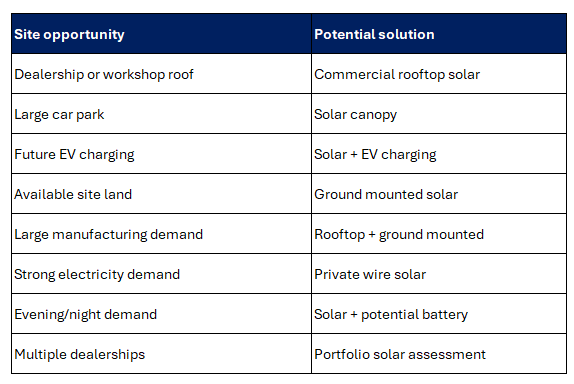
For both, there is an opportunity to look at commercial rooftop solar, solar canopies, ground-mounted solar and, where appropriate, private wire systems. The financial case should be based on actual electricity consumption and the way the site operates.
The Energy Challenge for Automotive Businesses
Energy is becoming an increasingly important consideration for automotive businesses.
Vehicle manufacturers are placing greater emphasis on sustainability across their dealer and supplier networks, while businesses themselves are looking for ways to manage operating costs and reduce their exposure to electricity price increases.
The transition towards electric vehicles adds another consideration.
Dealerships are increasingly installing EV charging infrastructure, while larger automotive businesses may be considering charging for company vehicles, customer vehicles, forklifts or future commercial fleets.
This means that electricity demand at an automotive site may change significantly over the coming years.
When assessing solar panels for automotive businesses, it therefore makes sense to consider both today’s electricity consumption and what the site could require in the future.
The Cost of Doing Nothing
The financial case for commercial solar should not be considered in isolation from the cost of continuing to purchase electricity from the grid.
Every year a business continues to purchase electricity that could potentially be generated on-site is another year in which potential savings and renewable generation are not being captured. At the same time, automotive businesses can face increasing expectations from vehicle manufacturers, customers and wider supply chains around carbon reduction and ESG.
Energy Gain’s investment modelling for a real-world car dealership illustrates this point. The dealership was spending heavily on electricity and wanted to reduce its reliance on grid electricity without disrupting its day-to-day operations. The financial assessment compared continuing to purchase electricity with purchasing, financing or using a PPA for the proposed solar system.
Solar Solutions for Automotive Sites
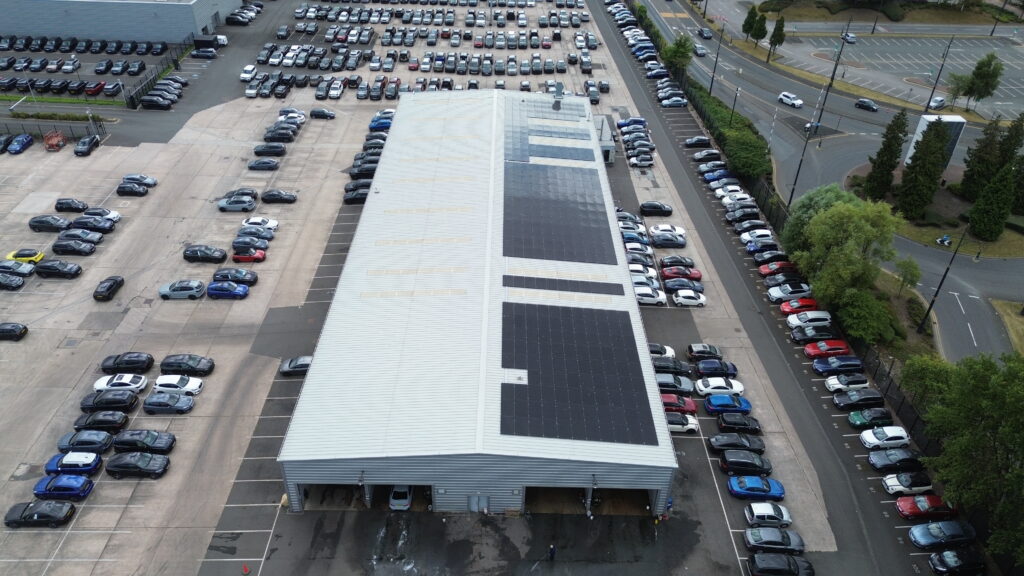
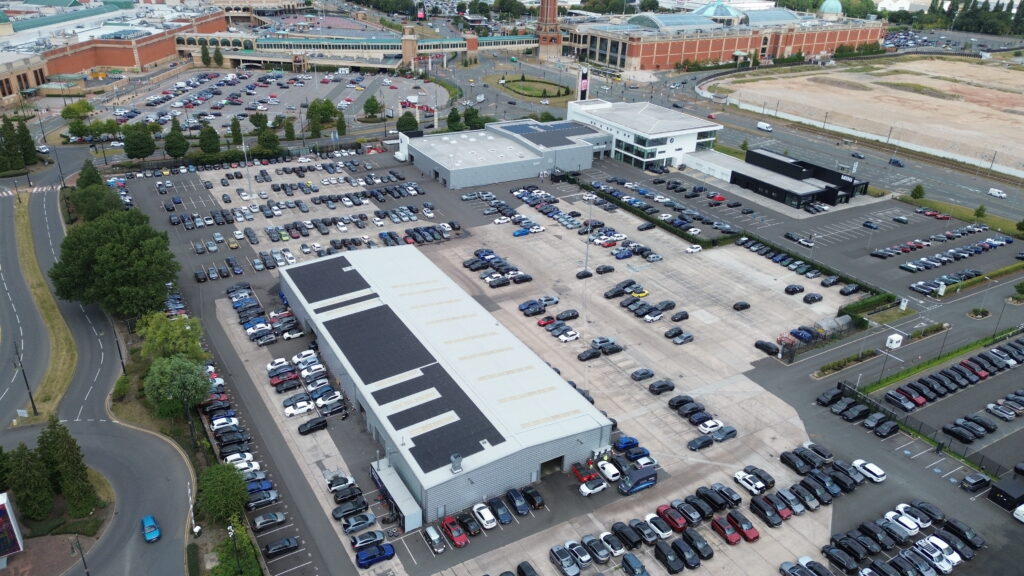
Rooftop Solar
Make use of available commercial and industrial roof space.
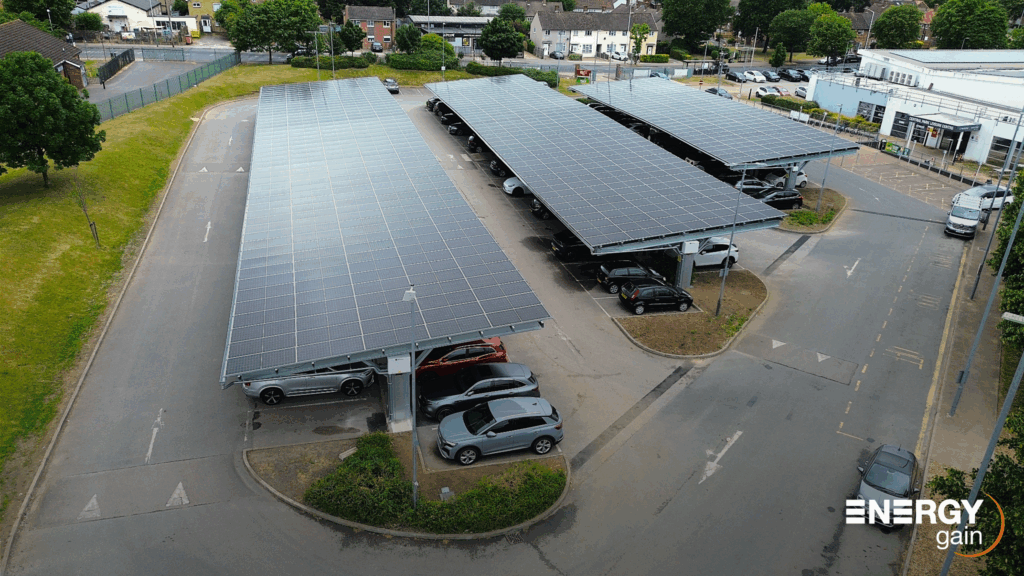
Solar Carports
Turn existing parking areas into solar generation space.
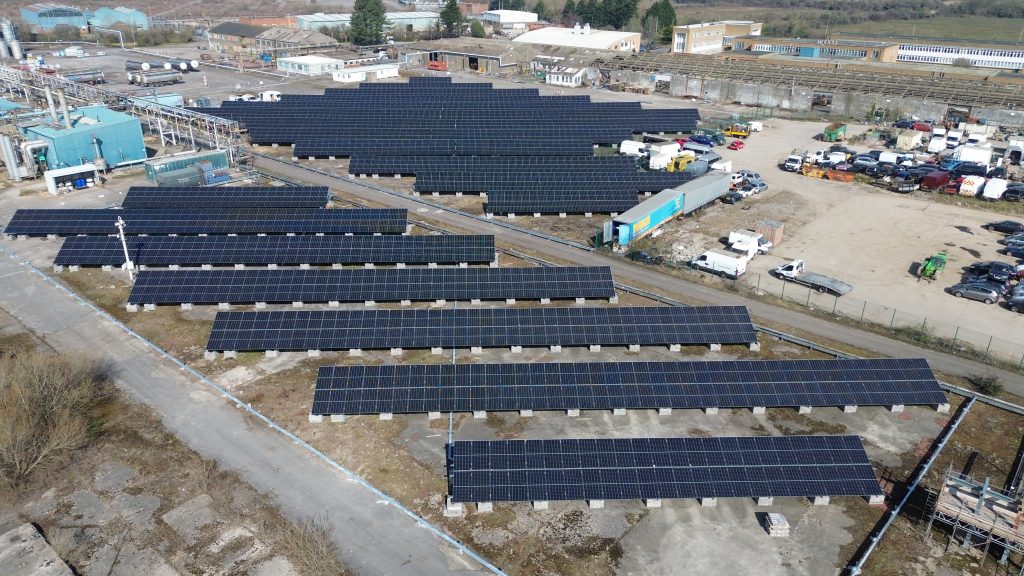
Ground-Mounted Solar
Utilise suitable land where additional generation is required.
EV Charging
Consider future charging demand alongside the site’s wider energy requirements.

Private Wire Solar for Automotive Sites
For larger automotive manufacturing facilities, private wire can provide another route to using renewable generation on-site.
A solar array can potentially be located away from the main building while being connected directly to the site’s electrical infrastructure.
The financial case should consider:
- Current electricity consumption
- Future electricity demand
- Solar generation
- Self-consumption
- Export
- Electrical losses
- Grid capacity
- Private wire infrastructure
- EV charging requirements
This approach is more complex than a standard rooftop installation, so it needs a proper engineering and financial assessment.
Automotive Solar case study:
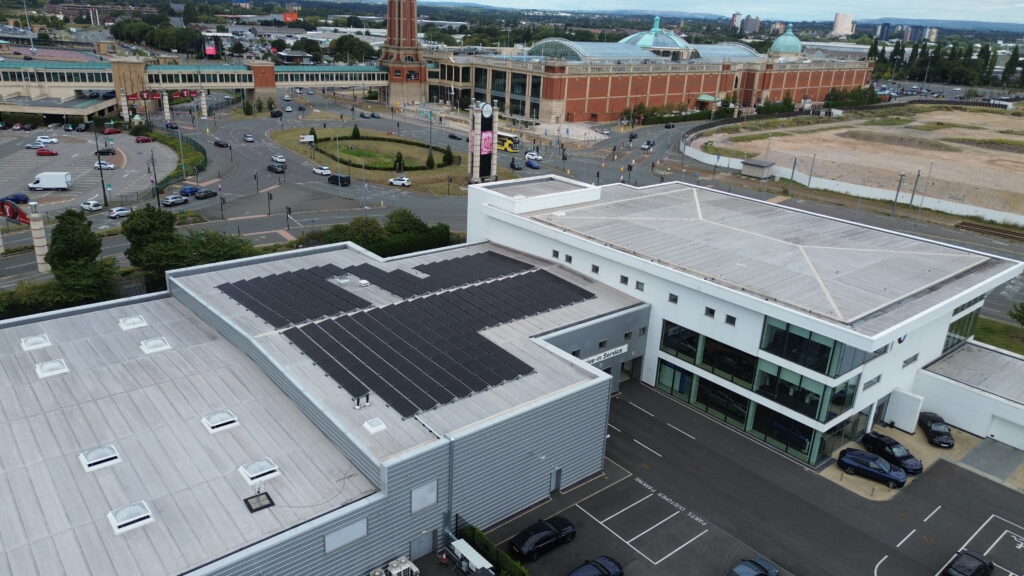
Energy Gain delivered a 270kWp rooftop solar PV system for BMW Williams at Trafford Park, Manchester, installing 540 panels across two separate roofs.
The system is expected to generate approximately 255,000 kWh of renewable electricity each year, helping reduce the site’s reliance on grid electricity and supporting its sustainability objectives.
The project also demonstrates how commercial solar can be designed around an operational automotive facility, with the system engineered to make effective use of the available roof space while maintaining safe access and allowing normal site activities to continue.
Automotive Manufacturing: Kasai UK
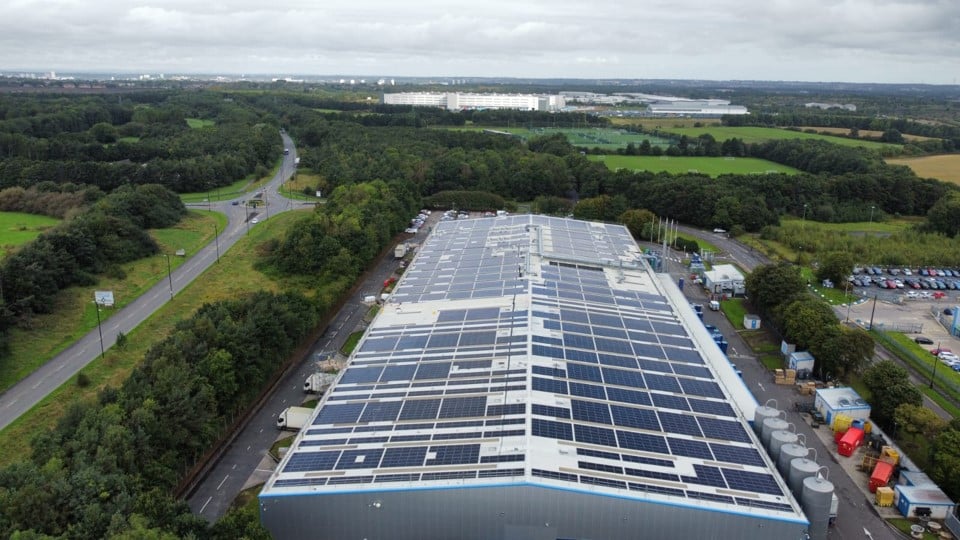
Energy Gain designed and installed a 1.45 MWp rooftop solar PV system for Kasai UK, an automotive component manufacturer supplying Nissan, Honda and JLR.
The system uses 3,411 solar panels and is expected to generate approximately 1,059 MWh of electricity each year, reducing the site’s reliance on grid electricity and saving around 201 tonnes of CO₂ annually.
The project was engineered around an operational manufacturing facility, with the installation carefully planned to maintain production while making effective use of the available roof space.
Financial Modelling Should Reflect the Real Site
The financial assessment should use actual electricity data wherever possible.
Energy Gain’s dealership business case considered:
- Historic electricity consumption
- Current electricity costs
- Half-hourly consumption
- Solar generation
- System degradation
- Maintenance assumptions
- Future electricity prices
- Self-consumption
- Export
This produced a cash-flow model that could be used to assess the investment over the operational life of the system.
That is considerably more useful than relying on a generic calculation based only on system size.
For a Finance Director or business owner, the important question is ultimately:
What return will this investment generate for our business, and what risks could affect that return?
What We Assess
Before recommending a solar system, Energy Gain considers the technical requirements of the site, including:
- Electricity consumption and operating patterns
- Roof construction and structural capacity
- Available roof or land
- Existing electrical infrastructure
- EV charging requirements
- Future electricity demand
- DNO and grid capacity
- Planning and site constraints
This ensures the proposed system is based on the requirements of the business rather than a standard system size.
The process begins with an assessment of your site’s energy use, available space and future requirements.
Energy Gain’s detailed desktop feasibility study can assess your electricity consumption, half-hourly usage data, roof or land availability, existing electrical infrastructure, grid requirements and potential future demand such as EV charging.
This helps establish whether solar is suitable for the site and identifies the most appropriate solution before progressing to detailed design.

Energy Gain develops a system designed around the site’s specific requirements.
The design considers factors including available roof space, structural requirements, solar generation, self-consumption, export and electrical infrastructure. Detailed financial modelling then assesses the expected investment, savings, payback and long-term returns.
Different system sizes and investment options can be modelled to identify the solution that provides the strongest technical and financial outcome for the business.

Energy Gain manages the delivery of the project from procurement through to construction and commissioning.
Our experienced installation teams work around the operational requirements of the site, with project planning focused on maintaining safety, minimising disruption and delivering the system to the agreed specification.
Once installation is complete, the system is commissioned and handed over with the relevant documentation and performance information
Solar performance doesn’t stop being important once the system is installed.
Energy Gain can monitor system performance to identify potential issues and ensure the installation continues to operate as expected. Performance data can be used to track generation and identify changes that may require investigation or maintenance.
Ongoing maintenance helps protect system performance and maximise the long-term value of the investment

Which Solar Solution Is Right for Your Automotive Business?
The answer will depend on the individual site. The important thing is to assess the options together rather than treating each technology separately.
Solar for the Future of Automotive
The energy requirements of automotive sites are changing.
Dealerships may be introducing additional EV chargers, while manufacturers and component suppliers may be electrifying production processes or increasing on-site electricity demand.
Considering these future requirements alongside today’s electricity consumption can help ensure the solar system remains appropriate as the business develops.
Calculate Your Automotive Solar Opportunity
Use our calculators to get an initial indication of the potential opportunity:
The calculators provide an initial indication. A detailed feasibility assessment can use your actual electricity consumption and site information.
Explore Your Automotive Solar Opportunity
Energy Gain can undertake a free, detailed desktop feasibility study to assess the potential for commercial solar at your automotive site.
We’ll consider your electricity consumption, site characteristics, future requirements and potential solar solutions to establish the technical and financial opportunity.