
Introduction
Commercial solar canopies provide businesses with an opportunity to generate renewable electricity while making productive use of existing car parks and external spaces. Unlike traditional rooftop solar installations, solar canopies are purpose-built steel structures that support solar photovoltaic (PV) panels above vehicle parking areas.
As well as generating clean electricity, commercial solar canopies provide weather protection for vehicles, create opportunities for electric vehicle (EV) charging infrastructure and demonstrate a visible commitment to sustainability.
For many organisations, a commercial solar canopy is more than an energy project. It is a long-term investment that reduces operating costs, improves ESG performance and enhances the value and functionality of existing property assets.
What is a Commercial Solar Canopy?
A commercial solar canopy, often referred to as a solar carport, is a structural steel framework installed above car parking spaces that supports commercial solar PV panels.
The electricity generated can be used to power the building, charge electric vehicles or, where permitted, be exported to the National Grid.
Unlike rooftop solar, commercial solar canopies require detailed civil, structural and electrical engineering, making them a specialist Engineering, Procurement and Construction (EPC) project.
How Does a Commercial Solar Canopy Work?
The process is similar to a rooftop commercial solar PV system.
- Solar panels convert sunlight into direct current (DC) electricity.
- Inverters convert DC electricity into alternating current (AC).
- The electricity is used within the building.
- Surplus electricity can charge electric vehicles or be exported to the grid.
- Remote monitoring continuously measures system performance.
The financial performance of the system depends on how much electricity is consumed on site, making energy profiling an essential part of the design process.

Where Are Commercial Solar Canopies Used?
Commercial solar canopies are suitable for a wide range of locations, including:
- Manufacturing facilities
- Distribution centres
- Office developments
- Retail parks
- Supermarkets
- Car dealerships
- Hospitals
- Universities
- Schools and colleges
- Local authority car parks
- Leisure centres
- Airports
Any site with significant parking areas and daytime electricity demand may benefit from a commercial solar canopy.
Why Are Businesses Investing in Commercial Solar Canopies?
Businesses are increasingly looking beyond rooftop solar where roof space is limited or where additional renewable generation is required.
Commercial solar canopies offer several advantages:
- Generate renewable electricity from existing parking areas.
- Reduce imported electricity and operating costs.
- Support electric vehicle charging infrastructure.
- Improve ESG and Net Zero performance.
- Provide shelter for employees and visitors.
- Create a productive long-term business asset.
- Improve the visual appearance of commercial premises.
- Demonstrate investment in sustainability.
For many organisations, commercial solar canopies also maximise the value of land that would otherwise be used only for vehicle parking.
Commercial Solar Canopies and EV Charging
Commercial solar canopies are often designed alongside electric vehicle charging infrastructure.
As businesses transition their vehicle fleets towards electric vehicles, solar canopies provide an opportunity to generate electricity close to where it is consumed, reducing the cost of charging and supporting wider decarbonisation strategies.
While the solar PV system and EV charging infrastructure can operate independently, designing both systems together often delivers the best long-term solution.
Why Engineering Matters
Unlike rooftop solar installations, commercial solar canopies are significant civil engineering projects.
Every installation requires consideration of:
- Structural engineering
- Foundation design
- Wind loading
- Snow loading
- Drainage
- Existing underground services
- Traffic management
- Vehicle movements
- Construction sequencing
- Electrical infrastructure
- Grid connection requirements
These engineering considerations are fundamental to delivering a safe, durable and high-performing commercial solar canopy.
The Importance of Energy Profiling
The success of a commercial solar canopy is determined by how the business consumes electricity.
Rather than designing the largest possible system, Energy Gain analyses half-hourly electricity consumption data to understand when electricity is used throughout the day.
This allows the solar canopy to be engineered around the site’s operational profile, maximising self-consumption and improving long-term financial performance.
Typical Commercial Solar Canopy Components
A commercial solar canopy typically includes:
- Structural steel framework
- Reinforced concrete foundations
- Commercial solar PV modules
- String inverters or central inverters
- Electrical distribution equipment
- Monitoring platform
- Cable management systems
- Rainwater drainage
- LED lighting (optional)
- Electric vehicle charging points (optional)
Each component is engineered to provide a safe, reliable and long-lasting installation.
Why Choose a Solar Canopy Instead of Rooftop Solar?
For many organisations, rooftop solar remains the preferred solution. However, commercial solar canopies provide an excellent alternative where:
- Roof space is limited.
- The roof is unsuitable for solar.
- Additional generation capacity is required.
- EV charging infrastructure is planned.
- Businesses want a highly visible sustainability investment.
- Parking areas offer greater generation potential.
Many organisations install both rooftop solar and commercial solar canopies as part of a wider energy strategy.
Expert Insight
Commercial solar canopies should never be viewed as simply adding solar panels above a car park. They are complex Engineering, Procurement and Construction (EPC) projects requiring structural engineering, civil engineering, electrical design and detailed project planning. The most successful projects begin with understanding the client’s operational requirements before developing a solution that balances engineering performance with long-term financial return.
Project Insight
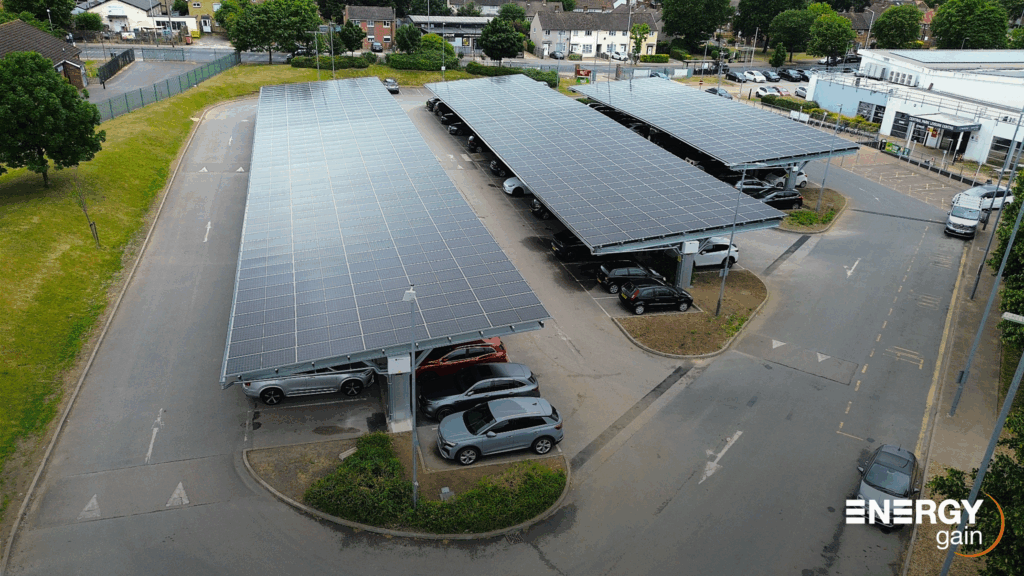
Case Study – Central Park Leisure Centre, Havering Council – Leisure
Include:
- Site Name: Central Park Leisure Centre
- Sector: Leisure
- Installed capacity (kWp): 369
- Number of parking spaces covered: 115
- Annual electricity generation: 309,000 KWh
- Annual carbon savings: 64 Tonnes
- Why a solar canopy was selected instead of rooftop solar
The site already benefited from a rooftop solar PV installation, but detailed analysis confirmed there was still significant daytime electricity demand, primarily from the leisure centre’s swimming pool, HVAC systems and plant equipment. This provided an excellent opportunity to expand renewable generation through the installation of three commercial solar canopies within the existing car park. The canopies were connected to the main plant room via underground cable ducts, allowing the new generation assets to integrate with the site’s existing electrical infrastructure while maintaining a safe and unobtrusive installation.
FAQs
What is a commercial solar canopy?
A commercial solar canopy is a steel structure installed above car parking spaces that supports solar PV panels to generate renewable electricity.
What is the difference between a solar canopy and rooftop solar?
Rooftop solar is installed on existing buildings, while commercial solar canopies are purpose-built structures constructed above parking areas or external spaces.
Can commercial solar canopies charge electric vehicles?
Yes. Solar canopies are often designed alongside EV charging infrastructure, allowing electricity generated on site to be used for vehicle charging.
Do solar canopies require planning permission?
Many commercial solar canopy projects require planning approval, although requirements vary depending on the location and scale of the development.
Are commercial solar canopies suitable for every site?
Not always. Ground conditions, parking layouts, underground services, electrical infrastructure and planning constraints all need to be assessed before a system is designed.
Key Learning Points
After completing this lesson you should understand:
- What a commercial solar canopy is.
- How commercial solar canopies generate electricity.
- Where solar canopies are typically installed.
- The benefits of commercial solar carports.
- Why engineering and project planning are critical.
- Why energy profiling determines the optimum system design.
Lesson Summaries:
- Lesson 1: What are commercial solar canopies?
- Lesson 2: Is your site suitable for a commercial solar canopy?
- Lesson 3: Building the financial business case for a commercial solar canopy
- Lesson 4: Pre-construction planning
- Lesson 5: Construction & installation
- Lesson 6: Commissioning, testing, and handover
Related Services:
Energy Gain solar canopy service
Solar canopy cost and savings calculator
Return to Knowledge Hub
