
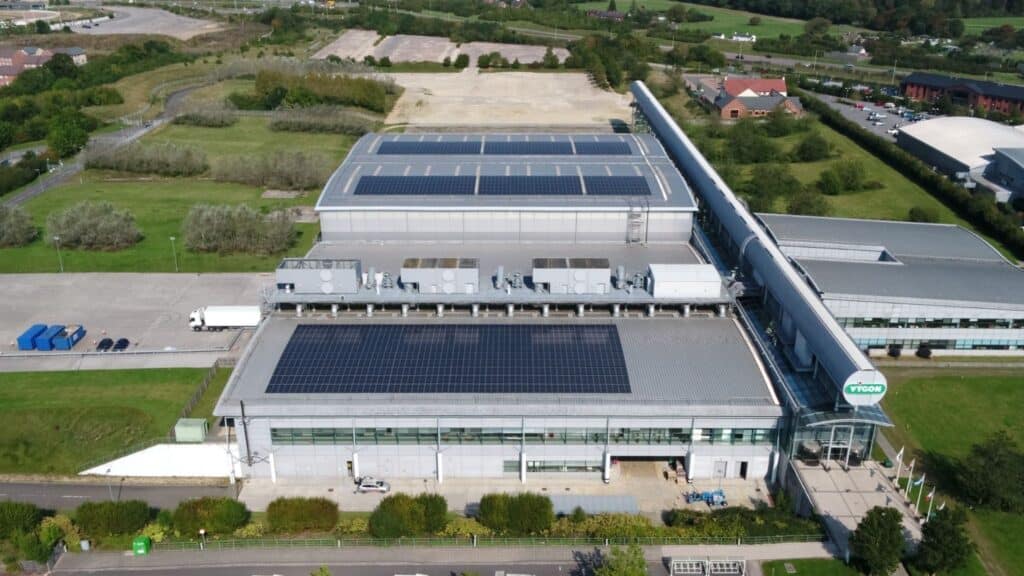
Commercial solar panels represent a significant long-term investment, so it’s important businesses research all available options. Getting it right delivers lower energy costs, improved carbon performance and greater resilience against future electricity price rises. Make the wrong choice and a business risks being disappointed by an overly complex installation that delivers less energy and lower cost savings than hoped.
Choosing The Best Solar Panels For Commercial Use
For most business installations, monocrystalline and bifacial panels have become the preferred option because they offer a strong balance of efficiency, durability and performance. As their name suggests, monocrystalline panels are made from a single crystal structure, allowing them to convert sunlight into electricity more efficiently than many older models. Bifacial panels offer the advantage of capturing direct light on one side of the panel and reflected light on the other.
These technologies typically offer panel efficiencies of around 20% to 23% which can be particularly useful when roof space is limited and setting up additional ground-mounted panels is not an option. These higher efficiency panels are also well suited to roof layouts where sunlight is not always direct or is interrupted by surrounding buildings or trees.
Reliability Must Be Central To Your Decision
Reliability is just as important as efficiency. A commercial solar installation is expected to operate for decades, so the financial strength and track record of the manufacturer matter. That’s why companies will find it reassuring to select panels from a company with Bloomberg NEF Tier 1 status. It’s used as a benchmark to show a manufacturer has been assessed as bankable by lenders and has supplied panels to large, qualifying projects. While Tier 1 status should not be the only factor in a decision, it is a useful starting point when assessing whether a supplier is likely to offer consistent quality and remain active in the market.
Businesses should also consider the quality assurance process behind the panel. Reputable manufacturers invest in testing, certification and production controls that help reduce the risk of early failure. This matters because when choosing the best solar panels for commercial use, companies are thinking beyond the asset itself. The decision is often made as part of a wider business case balancing capital expenditure with payback periods and carbon reporting. Confidence in the panel’s long-term performance helps protect that business case.
Understanding Wattage’s Impact On Installation
Wattage is another area where it is worth looking carefully at the detail. Solar panels for commercial use commonly range from around 400W to 650W. Higher-wattage modules can reduce the total number of panels needed to reach a target system size. In turn, fewer panels can mean fewer clamps, rails, cables and electrical connections, which may simplify installation and reduce the number of roof penetrations and mounting points required.
It would be easy to think, then, that going for the higher wattage is always the natural solution. However, larger units can be heavier and require careful handling, particularly on roofs with restricted access or limited loading capacity. The aim should be to select a panel that supports an efficient design without creating unnecessary installation complexity. A professional assessment should take account of roof condition, available space, orientation, shading, structural capacity and the business’s typical energy use.
Look Beyond The Headline Warranty
Warranties are often promoted prominently, but it is important to understand what they cover. A product warranty protects against defects in the panel itself, while a performance warranty sets out how much output the panel is expected to retain over time. As a guide, businesses should look for a product warranty of at least 12 years, alongside a performance warranty of 25 years or more. Stronger warranty terms can give additional reassurance, provided they are backed by a manufacturer with the financial stability to honour them.
All solar panels experience some decline in output over their lifetime, but the rate of degradation varies by product. A good performance warranty should make clear what percentage of the original output the panels are expected to deliver after 20 or 25 years. This helps businesses make more informed decisions over the lifetime value of an installation.
Forecasting Real-World Performance
Panel datasheets are useful, but they don’t provide a complete picture of how a system will perform once installed. Real-world yield depends on a combination of local weather, roof orientation, tilt angle, shading, temperature and system design. Accurate forecasting should use local data for irradiance, temperature and wind velocity to estimate expected energy yield in kWh per kWp. This gives a far more realistic indication of performance than relying on standard test conditions, which don’t always reflect the day-to-day environment on a roof.
Making The Right Long-Term Investment
Ultimately, the best decision on solar panels for commercial use will build an attractive business case for a company’s long-term energy strategy. Roof type, available space, budget, energy demand and future plans all play a role. The final decision must also factor in panel efficiency and wattage as well as warranty strength, manufacturer reliability, alongside a professional real-world yield forecast. There are a lot of points to consider and so, to help reach the right decision, contact Energy Gain for a free, no-obligation solar report tailored to your business.
